Carney Designates KLLNG and NCTL "Nation-Building"; LNG Canada Flaring Continues
Highlights
- Prime Minister Carney announced in Terrace today that Ksi Lisims LNG (with PRGT) and the North Coast Transmission Line would be taken on by the Major Projects Office as "nation-building projects," alongside a vague "Northwest Critical Conservation Corridor"
- News reporting indicated LNG Canada's second train is fully operational a week ago, but ongoing unplanned flaring continues to suggest otherwise
Got tips?
If you have access to unpublished information about these projects or about LNG in BC more broadly, check out our Tips page for information on secure channels.
The more reach this newsletter has, the more likely it is we'll be able to obtain information that isn't available elsewhere. Please share with friends, colleagues, and anyone who may be interested in staying up-to-date on the latest developments with these megaprojects.
Details
KLLNG, NCTL, and "Critical Conservation Corridor" Major Projects Office Designations
Earlier this year, Prime Minister Carney created the Major Projects Office to "advance major projects and streamline federal regulatory project approval" as part of Bill C-5, the Building Canada Act. A first round of projects was announced in September, including, regionally, the Red Chris mine expansion. Today, Carney was in Terrace, BC alongside Mayor Sean Bujtas and Nisga'a Lisims Government President Eva Clayton to announce a new round of "nation-building" projects including both the North Coast Transmission Line and Ksi Lisims LNG (including PRGT under this header), along with a more nebulous new "Northwest Critical Conservation Corridor" which we'll discuss below.
What does this designation do, and what does it mean for the projects? Media has credulously and repeatedly reported that designation means "fast tracking" approvals. But virtually every project listed so far, including Ksi Lisims LNG and the Red Chris mine expansion, were already fully approved when they were designated. Despite all the talk about "fast track" legislation at both provincial and federal levels, these projects can't actually be fast-tracked given that they've already gone through Canada's environmental permitting process.
If it is not streamlining approvals, what is it doing? The MPO claims it will help projects secure financing, which is the big question mark holding Ksi Lisims and PRGT back right now. The funding environment for new LNG projects looks increasingly grim from a global perspective, as does the long-term market. Western LNG, a small, Texas-based company that has never built anything, needs access to $22+ billion (likely much more once cost estimates are updated). The MPO will help the company access public funds, but in our assessment, it remains unlikely that that the federal government will contribute more than a few hundred million in direct project financing and perhaps a few billion in "loan guarantees," which leaves the bulk of the project still awaiting private financing. Carney and the project's backers are both undoubtedly hoping the message of support this designation brings will be enough to convince financiers to back the project. Whether it works remains to be seen. This designation alone does not seem to be enough to guarantee a final investment decision for either LNG Canada Phase 2 or Ksi Lisims LNG.
The NCTL is a different story: Premier Eby has been charging ahead with this for the last few months and publicly asking the federal government to finance half the project. This announcement doesn't seem to include a commitment to spend those $3bn, but presumably Eby and Carney have had discussions about this behind closed doors and there's more information about who will fund the project to come. It is a safe bet, at this point, to assume they will start building this in 2026.
What is the "Northwest Critical Conservation Corridor?"
The government made a passing reference to this idea earlier in the year, but details were sparse, and they remain so. Here is what was in today's press release:
Today, the Prime Minister referred the Northwest Critical Conservation Corridor in Northwest British Columbia and the Yukon to the MPO. This Corridor sits atop vast deposits of critical minerals and has the potential to unlock world-class resources while creating a conservation area the size of Greece.
Referring this Corridor to the MPO ensures it can realise its extraordinary potential for critical minerals development and clean power transmission, while upholding Indigenous rights and supporting Indigenous project leadership.
This Corridor will fundamentally transform the lives of thousands of Canadians, position Canada as a global leader in critical minerals, and drive prosperity across the country. Realising this potential will require a coordinated effort with provincial and Indigenous partners to build transmission lines, upgrade highways, install fibre and cell towers, and invest in communities, ports, and railway lines. Infrastructure investments under this strategy also link clean electricity to Canada’s ability to export LNG. Extending transmission to the Yukon can also power the North and has the potential to unlock additional resources.
It is a bit Orwellian: Canada will meet its conservation goals, conserving an "area the size of Greece," by creating a new jurisdictional designation that will "unlock world-class resources" and allow access to "vast deposits of critical minerals." What?
It is concerning to see this vague designation "referred" to the MPO: on one end of the spectrum, the "corridor" could just be a branding exercise for the wave of new mines, transmission lines, and LNG projects they are already pursuing. On the other end of the spectrum, it could represent something akin to a Special Economic Zone: a new jurisdictional designation that allows the government to apply entirely different legal (and potentially security) regimes within its bounds, opening it up to international capital in ways that are not possible under normal Canadian law. CBC called it "more of a concept than a project;" at this point, we simply don't know what is being proposed here, but it is something to watch closely.
Indigenous leaders opposed to Ksi Lisims LNG held a press conference after Carney's making it clear they intend to continue to fight the project, which, as mentioned in previous updates, is subject to multiple ongoing legal challenges from First Nations in the region.
LNG Canada Flaring Indicates Train 2 Still Not Fully Operational
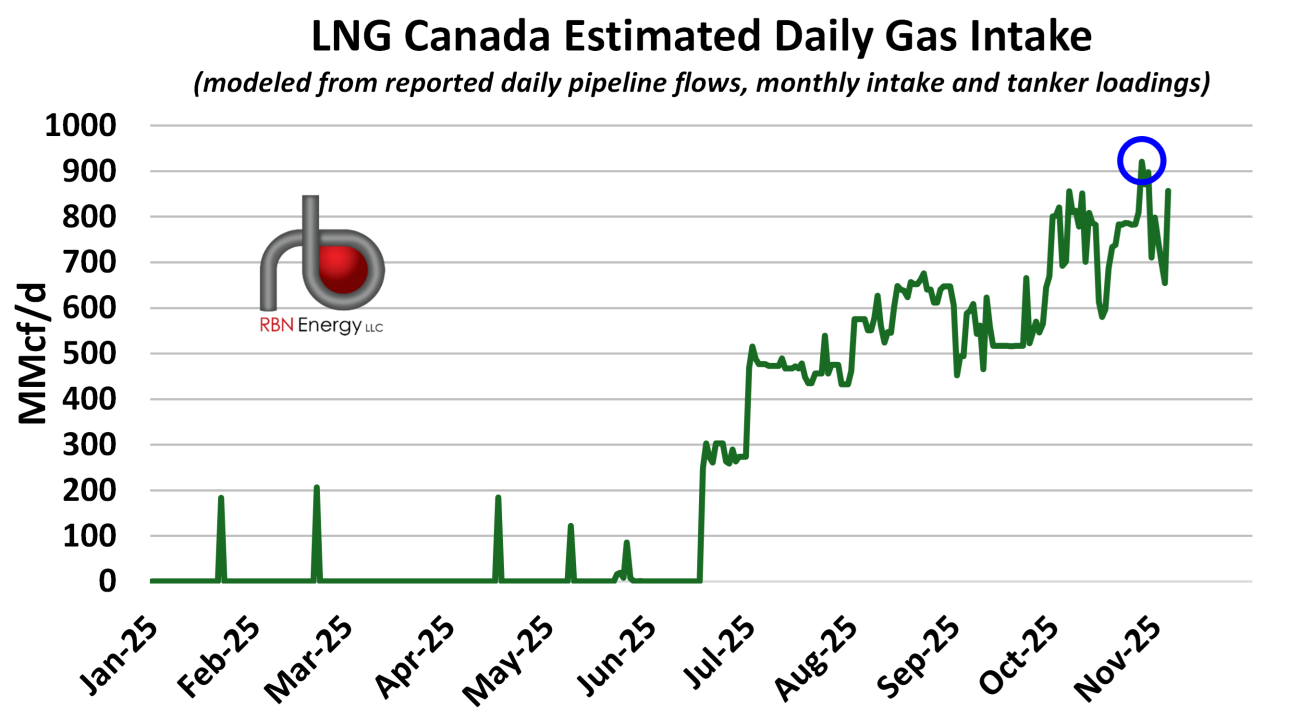
"Canada’s first large-scale LNG export project firing on all cylinders as it ignites second train." "LNG Canada brings second train online, doubling export capacity." Reporting in the first week of November followed an LNG Canada press release in announcing that the facility was fully operational. Three days after the press release, LNG Canada announced another 10 days of flaring up to 90m high, suggesting that claims of full operation remain significantly overstated. We will continue to watch various estimates of pipeline inflows and tanker traffic over the coming weeks, but don't expect the project to be "fully operating" for some time.
In the meantime, flaring has been causing serious harm to the residents of Kitimat. The Narwhal reported on November 4th that LNG Canada has been offering hush money to residents conditioned on agreements that both release them from legal liability for harm resulting from the air pollution and prevent them from speaking about the harm caused.
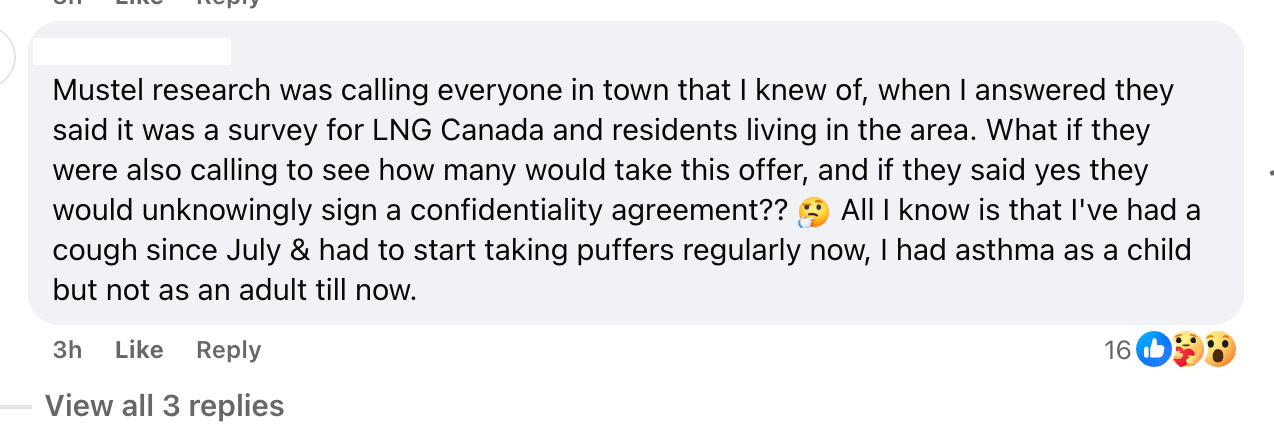
If you know anything more about this or have received one of these offers yourself, head to our tips page.