LNG Canada issues and ownership shuffle; Quiet few months for PRGT/KLLNG
Highlights
- LNG Canada production fell dramatically in December due to technical issues, but has recovered and has risen throughout January
- The Narwhal reports that LNG Canada has a major issue with its flare stack
- Reuters reports Shell and Mitsubishi, the two largest investors, are looking into selling their stakes in LNG Canada
- LNG tanker from LNG Canada turns around mid-Pacific and heads to Europe for better prices
- PRGT and Ksi Lisims LNG continue in holding pattern awaiting potential final investment decision
Got tips?
If you have access to unpublished information about these projects or about LNG in BC more broadly, check out our Tips page for information on secure channels.
The more reach this newsletter has, the more likely it is we'll be able to obtain information that isn't available elsewhere. Please share with friends, colleagues, and anyone who may be interested in staying up-to-date on the latest developments with these megaprojects.
Details
LNG Canada Production
According to RBN Energy, which models gas inflows based on a combination of the pipeline data we were using in earlier issues of this newsletter and tanker traffic, December saw a dramatic decrease in gas intake. A series of incidents, including a restart caused by a BC Hydro power outage, caused both production trains to be down for a significant portion of the month.
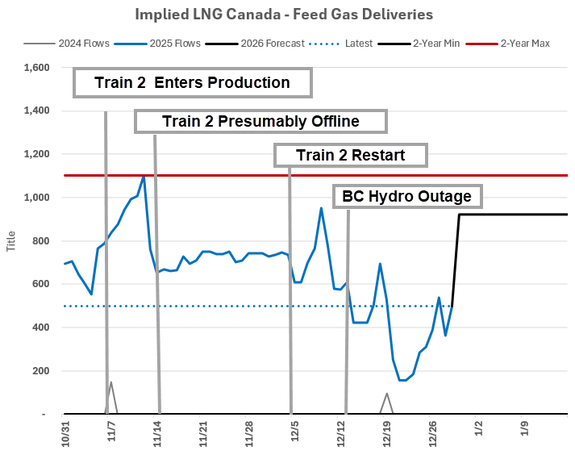
On January 22nd, RBN estimated that gas intake for January will hit 1,200 MMcf/d, a record high and bringing the facility closer to its stated capacity, which RBN estimates at 2,100 MMcf/d.
LNG Canada Flaring Issues
As The Narwhal reported, LNG Canada has a major equipment problem with its flare stack that will reportedly take three years to fix—if they fix it at all. This issue does not prevent them from operating, although it has likely played a role in the project's haphazard ramp-up, but it does mean that the project has to burn far more gas during normal operations than it would otherwise. On one day in September, it burned 150 times what it would during normal operation: 1.7 million cubic metres of gas. It has, according to the Narwhal, "consistently burned upwards of 15 times more gas than typical for months on end." This means higher costs—they pay for the feed gas that they burn, just like they pay for the feed gas that they liquefy—as well as significant air quality and quality of life impacts for Kitimat, with air quality impacts possibly traveling further afield (i.e. to Terrace).
It also appears to mean, though LNG Canada refused to answer the Narwhal's questions, that significant flaring will continue until the issue is resolved—which, again, could take three years—despite consistent claims that this was a startup-phase issue only.
Shell and Mitsubishi Selling Stakes
On January 16th, Reuters broke the news that Shell and Mitsubishi are looking to sell either a portion or the whole of their stakes in LNG Canada. They are the two largest partners in the ownership consortium. At this time, we don't know why they are selling. Industry insiders have insisted that it is to free up capital for other investments, possibly including the phase 2 expansion, while others have argued that it is a result of the broader trouble in the LNG market, the facility's technical problems, and a disinterest, among the original consortium, to move the project forward.
Today, the Globe and Mail reported that two "industry sources...not authorized to speak publicly on the matter" indicated that the sale is specifically to raise capital for LNG Canada Phase 2. In our opinion, this does not carry any more weight than the speculations made publicly. As with the Reuters exclusives that often cite similar anonymous industry sources, it seems likely that these conversations with media are framed as anonymous in order to lend them credibility, but are in fact part of a corporate communications strategy. The anonymous conversations with the Globe and Mail may have been a response to public skepticism about the implications for LNG Canada Phase 2.
LNG Tanker Turnaround
Yesterday, the Qingcheng LNG carrier, which left LNG Canada on January 20th, reportedly turned around in the middle of the Pacific Ocean. Argus Media, the commodity analytics firm that reported the turnaround, speculates that it may be heading through the Panama Canal to Europe, where it could access a significantly higher price due to sagging spot prices in Asia and cold weather in Europe. Suffice to say this is a tenuous move in terms of profitability because of the significant additional costs, and it's a symptom of the declining structural outlook for LNG demand in Asia.
PRGT, Ksi Lisims LNG, Spinning Their Wheels
A reminder: PRGT and Ksi Lisims LNG have not seen any construction occur since November, 2024, despite being fully permitted. There have, at times throughout 2025, been environmental consultants collecting data in a few locations, but no actual work—movement of earth, that kind of thing—has happened. At this time, according to Western LNG's latest monthly update, nothing at all is happening, and there is no sign of this changing in the near future.
The company has made a number of different statements about when they expect their FID over the last year. In September, 2025, CEO Davis Thames said that the company was "months away from completing an engineering, procurement and construction contract, and are about halfway through the debt financing process." In January, 2026, Rebecca Scott, the company's spokesperson, told the Vancouver Sun that they expect to reach a final investment decision by the end of March.
In our opinion, there is little reason to believe this claim. While an FID could come at any time—which would be followed, at some point, by a ramp-up in actual construction—there is little evidence at this point that the company is making progress. Notably, it has failed to announce any additional offtake agreements since the May 2025 agreement with TotalEnergies.